
Price the Engine, Not the Average
Fixed-price shop visits are won or lost at the bid. How engine MROs can use the data they already own to predict workscope and price the specific engine.
How engine shops can turn the data they already own into workscope predictions and bids they can defend, with the KeepFlying® FinTwin®.
The margin is decided before the engine arrives
On a fixed-price shop visit, much of the MRO's margin is decided the day the bid is signed.
After that, the engine tells you what it needs. The blades are either repairable or scrap. The life-limited parts either have the cycles or they don't. The bid either anticipated those findings or it didn't.
Most contracts today are fixed price, flat rate or capped, at least for the routine portion of the work. The customer has effectively moved much of the variability risk onto the shop.
Yet many MROs still price a visit using a rate card, a few comparable invoices and an estimator's experience. That means they are often pricing the average engine.
The problem is that nobody ever inducts the average engine.
The engine on the stand has its own history. Where it flew. How hard it was operated. Which modules were opened last time. Which LLPs were installed. Which service bulletins have been embodied. How much life remains on individual parts.
Most of this information already exists inside the shop. It is just spread across different systems, reports and spreadsheets that rarely come together until well after the work is complete.
The opportunity is to bring that information together before the bid and price the engine that is actually coming through the door.
One shop visit, read closely
We recently looked closely at the financial records from a V2500-A5 performance restoration. This was a financial teardown rather than an engine teardown.
The invoice workbook contained dozens of tabs covering ERP extracts, labour bookings, purchase orders, subcontract bills, price catalogues, LLP tracking and the final invoice summary. We cross-checked the data against the engine's maintenance management plan.
Seven things stood out. None of them would have been obvious from a rate card.
1. The bid is really a materials forecast with labour attached
Roughly half the value of the visit sat in a single module, the HP turbine.
New blades, vanes and seal segments accounted for much of that value. Labour and overheads were a relatively small part of the total.
That means getting the scrap rates right on a handful of hot-section part numbers can matter more to the final margin than getting every labour hour exactly right.
2. LLPs were replaced because of condition, not life
Two turbine hubs and an air seal were scrapped because of corrosion pitting and an out-of-limit bore dimension.
A model that only looks at remaining cycles would have missed all three. It would also have missed some of the largest cost items on the invoice.
Remaining life tells you when an LLP is expected to reach its limit. It does not tell you what condition the part will be in when it gets there.
3. The build goal quietly shaped the workscope
Several other LLPs left the shop with relatively modest life remaining, which limited the engine's next run.
That likely influenced why some modules received lighter work than their soft times might otherwise have suggested.
It also meant that the new turbine LLPs installed during the visit had considerably more life than the engine was likely to consume before its next LLP-driven visit.
That is a commercial decision with a real financial impact. Yet it is rarely made explicit when the original bid is prepared.
4. The billed maintenance level had drifted from the current manual
One module was invoiced at a maintenance level that no longer exists in the current eMMP revision. The shop had used a job card from an older revision.
Other modules were completed below the levels indicated by the current soft times.
These gaps may not matter immediately, but they can become problems later, particularly during redelivery or when a customer challenges whether the contracted work was actually performed.
5. Hours booked were well ahead of hours sold
The core modules made money on labour. Gearbox, bearing and exhaust modules did not.
There were also dozens of repair and defect work orders with no corresponding line on the invoice.
The work had been done. The labour had been spent. It simply had not been recovered.
6. The two books disagreed on cost
The invoice workbook and the labour ledger were using very different cost rates per hour.
That made the reported labour margin look considerably healthier than the underlying ledger suggested.
If the cost base is wrong, even a perfectly accurate revenue analysis can give the wrong answer.
7. Some big numbers were not revenue
Customer-furnished parts and exchange movements were running through the same data as billable material at list value.
Unless those items are separated properly, they distort both the original estimate and the post-visit margin analysis.
None of this is unusual. It is what happens when engineering, commercial and financial information live in different places and only come together in a spreadsheet after the engine has already shipped.
The data an engine shop already owns
Every shop visit is a labelled data point. It tells you what the engine looked like when it arrived, what was found during the visit, what was done and what it ultimately cost.
Most MROs have hundreds of these examples. Very few use them systematically to price the next engine.
The most useful inputs are usually already there:
The engineering logic connecting these inputs is well understood.
An engine that has spent years flying short sectors in a hot environment with relatively little derate will usually arrive with a different hot section from one that has flown long sectors in a cooler climate, even if the two engines have similar hours and cycles.
The eMMP tells you which modules need to be opened. Soft times give you a starting point for how far to go. Historical scrap and repair data tell you what is likely to be found once those parts are opened.
The missing piece is usually a system that applies all of that information to one specific engine serial number and translates the result into a commercial estimate.
From engine history to a bid you can defend
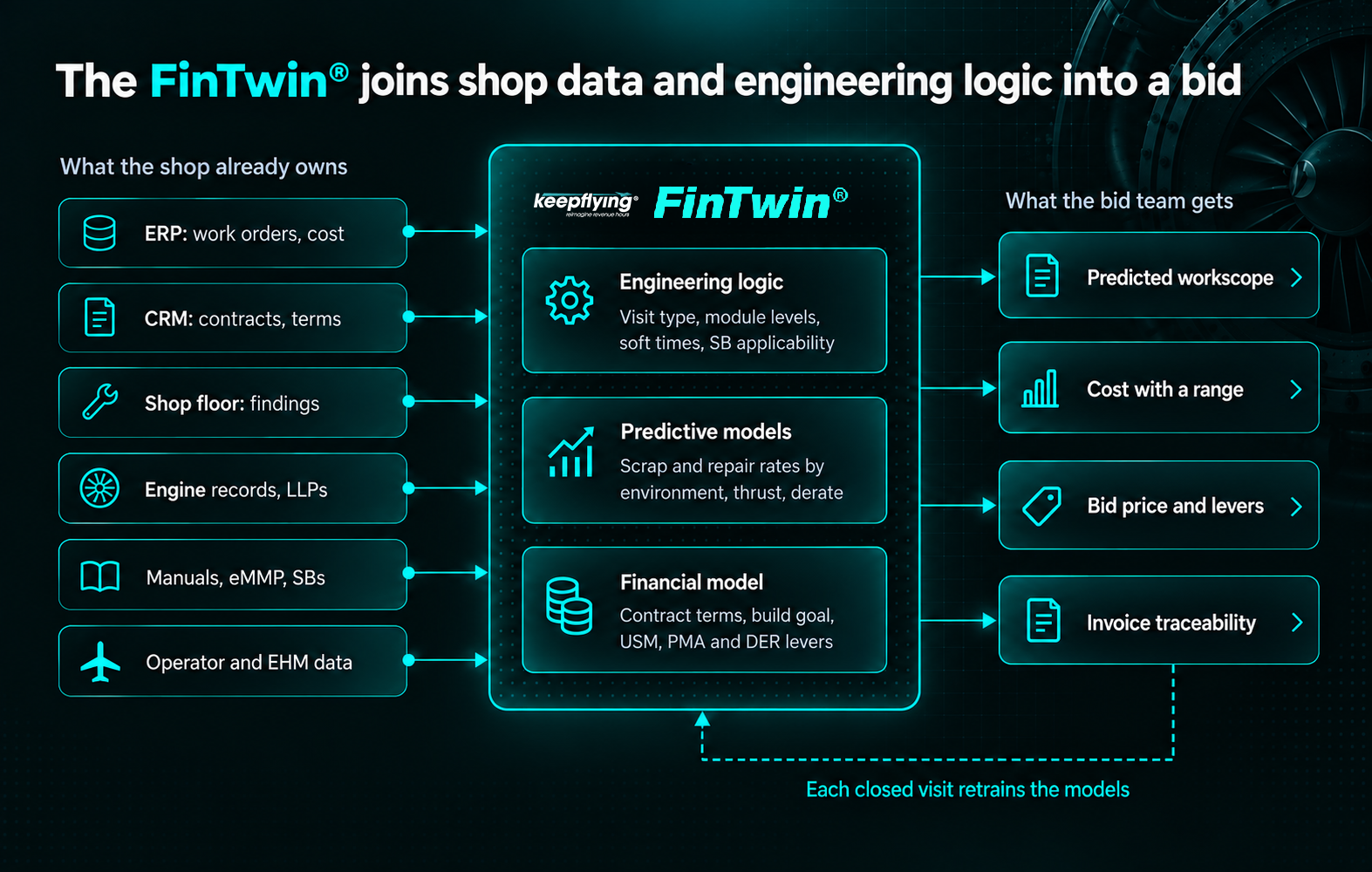
The KeepFlying® FinTwin® does not replace the MRO's ERP, CRM or shop-floor systems. It works with them.
It brings together the information already sitting in those systems and applies the engineering and commercial logic needed to turn it into a view of the specific engine being priced.
For the V2500 example above, that means the bid could have identified three things before the engine arrived:
- The hot section was where the main cost risk sat.
- The turbine LLPs had condition-related risk that could not be understood from remaining cycles alone.
- The LLP stack would constrain the next run, which should influence how deeply each module was worked.
That is a very different starting point from simply looking at what the last five V2500 visits cost.
The commercial levers in a fixed-price world
Once the price is fixed, every material and repair decision made on the shop floor affects the margin. Those decisions are much easier to manage when they have already been considered during the bid.
Used serviceable material
Replacing a new hot-section part with a serviceable or overhauled part can materially change the cost of a module.
But it only works if the remaining life, back-to-birth traceability and customer acceptance requirements all line up.
The FinTwin® can identify where USM is permitted, where the contract treats it differently and where using it could conflict with the engine's build goal.
PMA parts and DER repairs
PMA parts and DER repairs can be important cost levers, particularly for high-scrap expendables and airfoils.
But their use depends on the operator, lessor and return conditions. The question should be answered during the bid, not when the parts are already needed.
Repair versus replace
A part near its repair limit does not have a single predictable cost.
If historical data shows that a particular part is scrapped 40% of the time and repaired 60% of the time, that is a very different pricing assumption from simply treating it as a repair. On a fixed-price visit, that gap comes straight out of margin.
LLP build goal and stacking
Replacing an LLP restores its life. But the engine's next run is ultimately limited by the shortest-lived part in the stack.
That makes LLP replacement a commercial decision as much as a technical one.
The shop may decide to buy only the life it expects the engine to use, or it may recommend a fuller LLP replacement to give the customer a longer run. Either way, the choice should be visible in the bid.
Workscope level versus soft time
Going lighter than the soft times may reduce the cost of the current visit. It can also increase the risk of an earlier removal, additional warranty exposure or a dissatisfied customer.
Going deeper protects time on wing, but the additional work has to be justified and priced.
The decision should be based on the manual revision that actually applies to the engine, not an old job card sitting in a spreadsheet.
Return conditions
Lease return conditions can determine whether a lighter workscope is acceptable in the first place.
Minimum cycles remaining, maximum time since performance restoration and restrictions on part origin can all affect the scope.
If those requirements are captured in the commercial data and checked against the predicted workscope, the shop can avoid pricing a solution that the customer cannot ultimately accept.
Exchange and customer-furnished material
Exchange components and customer-furnished parts affect the cash and margin picture even when they do not represent revenue to the shop.
Keeping them separate from billable material makes both the original quote and the final margin analysis more useful.
A Financial Twin built around the engine
The KeepFlying® FinTwin® is designed around the way an engine shop already works.
It reads work orders, labour bookings, material issues, purchase orders, subcontract bills and commercial terms. It then brings in the engineering context: visit type, module levels, soft times, LLP build goals, historical scrap rates, operating environment and SB applicability.
The result is one view of the engine that connects the engineering decision to the financial consequence.
Before the bid
The shop gets a predicted workscope by module and level, an expected cost range rather than a single number, and the main factors driving the estimate.
That includes the parts carrying the most risk, LLPs likely to constrain the build and commercial options such as USM, PMA and DER repairs.
During the visit
As findings come in, the estimate can change.
If a turbine stage is declared scrap, the impact on the expected margin is visible while there is still time to adjust the material strategy or raise a commercial discussion with the customer.
After the visit
The completed invoice can be traced back to the work performed, the module involved and the applicable maintenance reference.
Unrecovered labour, inconsistent cost rates and workscope levels that have drifted from the applicable manual can be identified without waiting for a spreadsheet review months later.
Each closed visit then becomes another data point for the next prediction.
Price the engine in front of you
The engine shops that will win fixed-price work profitably will not necessarily be the ones with the lowest rate card. They will be the ones that understand the engine before they bid it.
They will know where the cost risk sits, which parts are likely to drive the invoice, what the LLP stack means for the next run and which commercial levers are actually available to them.
Most of that knowledge is already inside the shop. The challenge is bringing it together early enough to use it.
If your shop visit history still lives across spreadsheets and your best estimators carry the critical scrap rates in their heads, we'd like to show you what your own data can predict.
Get in touch with the KeepFlying® team to see the FinTwin® applied to one of your recent shop visits.
Ready to Transform Your Aviation Operations?
Discover how our AI-driven solutions can optimize your maintenance operations and reduce costs.