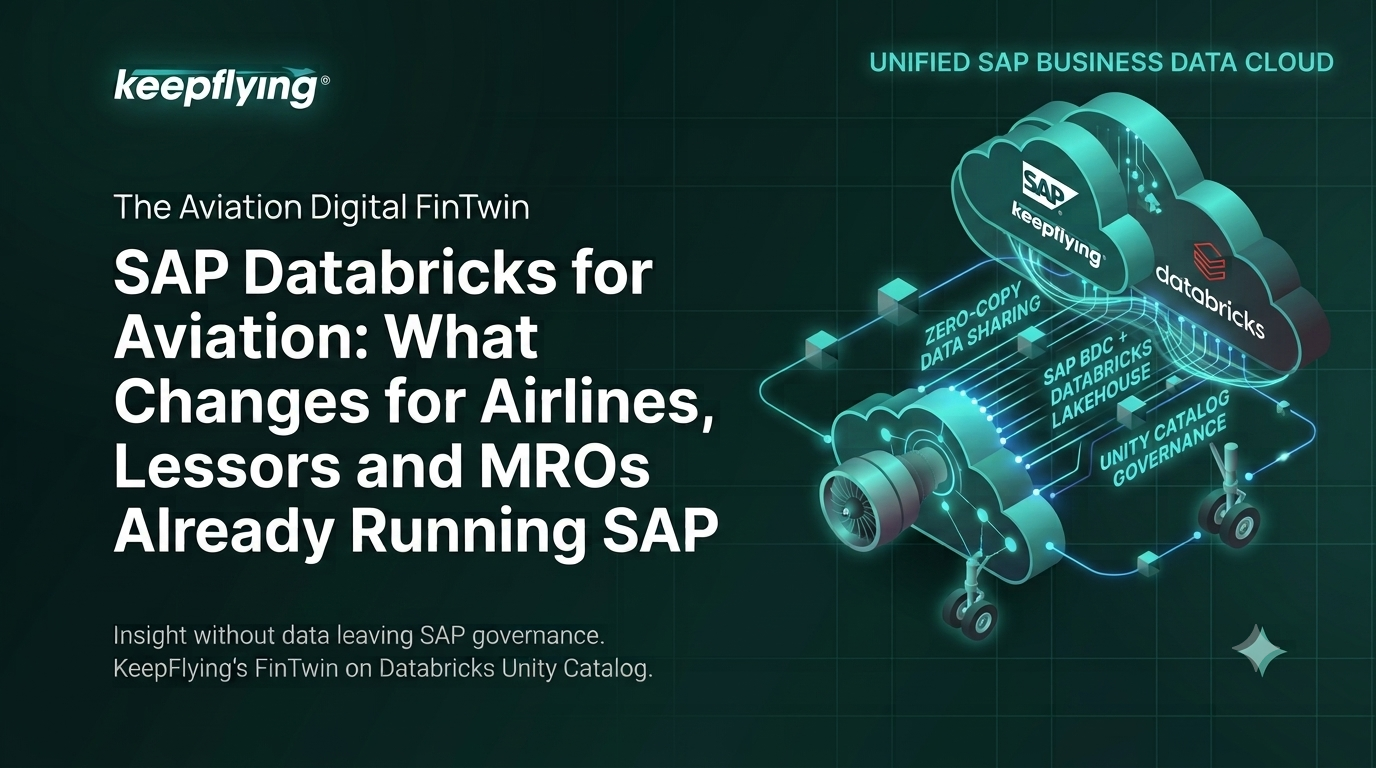
SAP Databricks for Aviation: What Changes for Airlines, Lessors and MROs Already Running SAP
SAP Databricks brings a lakehouse inside SAP Business Data Cloud. Here is what that means for aviation operators running S/4HANA, and how KeepFlying's FinTwin uses it.
SAP Databricks is Databricks running natively inside SAP Business Data Cloud. Your SAP data stays under SAP governance, and Databricks capabilities like Spark, machine learning and AI agents operate on it through zero-copy Delta Sharing rather than extraction pipelines. For aviation companies that run finance, procurement or maintenance on SAP, this closes a gap that has been expensive for a long time: the gap between what your ERP knows and what your AI can reach.
We build on this architecture, so we have opinions about it. Here is the honest version.
The problem SAP Databricks solves for aviation
Most aviation operators we talk to have the same shape of data estate. Financials and procurement sit in S/4HANA. Maintenance lives in AMOS, TRAX or an M&E module. Airworthiness records arrive as scanned PDFs, some of them decades old. Utilization data comes from lessee reports. None of it agrees with anything else without an engineer spending hours making it agree.
The challenge is rarely a lack of data. It is that the data cannot be reasoned over where it lives.
Until now the standard answer was to copy everything into a separate analytics platform. That meant ETL pipelines to build and maintain, a second copy of commercially sensitive data to govern, and a compliance conversation every time the copy drifted from the source. Aviation is a small industry with long memories and serious regulators. Data leaving governed systems is not a detail anyone waves through.
What SAP Databricks actually is
Three things, concretely:
A lakehouse inside SAP Business Data Cloud. Databricks runs as a native component of BDC, not as an external system you pipe data into. SAP business data products in the BDC catalog share into Databricks Unity Catalog with zero copies made.
Bidirectional sharing. Results flow back the other way. A model score, a forecast or a validated dataset produced in Databricks can be served into SAP Analytics Cloud or Datasphere, where your finance and asset teams already work.
Clean-core by design. Extensions run side-by-side on SAP BTP rather than as modifications inside the ERP. Your S/4HANA upgrade path stays intact.
The one-line summary we use with customers: insight without data leaving SAP governance.
Why this matters more in aviation than in most industries
Two reasons, and neither is about technology fashion.
First, the money at stake per decision is unusually high. Our analysis puts the average exposure from unvalidated utilization data at $89K per aircraft over an eight-year lease, with a single undetected discrepancy reaching up to $672K (KeepFlying analysis, reported versus independently observed utilization; methodology available on request). A narrow-body redelivery done on poor data can cost around $2M extra. An untested fixed-price commitment on an engine overhaul can leave $250K+ of profitability on the table. When decisions carry six and seven figures, the tolerance for stale or unverifiable data is low.
Second, aviation data is evidentiary. At redelivery, in a lease dispute, or in front of a regulator, you do not need a dashboard. You need a traceable line from the number on the screen back to the source record. That is hard to maintain across copied data. It is much easier when the data never moved and every transformation is logged in Unity Catalog lineage.
How FinTwin runs on SAP Databricks
KeepFlying's FinTwin is an intelligence layer, not another system of record. It connects the technical condition of an aircraft or engine to its financial story: cost, revenue potential, remaining useful life, risk. On the SAP Databricks architecture it works like this:
Your SAP data products share from the BDC catalog into Unity Catalog. No copies. FinTwin's agents then work over that governed data alongside the messy sources SAP never held: scanned airworthiness records read by aviation-trained OCR at 95%+ accuracy, utilization data cross-checked against independent flight tracking, maintenance records reconciled and standardised. Simulation outputs, shop visit forecasts at 85%+ prediction accuracy, and validated datasets are then served back into SAP Analytics Cloud where your teams already look.
Every answer traces to source. That is not a slogan, it is the design constraint that keeps hallucinations out of a domain where a wrong answer has a dollar figure attached.
We are a member of the SAP Partner Open Ecosystem, and we built for this architecture because it matches how our customers actually think about their data: they are not asking to take it somewhere new. They are asking to finally use it where it is.
What to do with this if you run SAP today
An honest sequencing note. The architecture is the enabler, not the outcome. If your airworthiness records are unstructured PDFs and your utilization figures are self-reported and unverified, putting a lakehouse next to your ERP does not fix that on its own. The data has to be made AI-ready first: collected, reconciled, cleaned, validated, with humans signing off where judgement matters.
That is why we start engagements with a records maturity assessment rather than a platform pitch. It scores data confidence asset by asset and tells you, before anyone commits budget, whether the gap is architecture or the data itself. Usually it is both, in a fixable order.

FAQ
What is SAP Databricks?
SAP Databricks is Databricks embedded natively in SAP Business Data Cloud. It gives SAP customers lakehouse, machine learning and AI capabilities on their SAP data through zero-copy Delta Sharing, with governance staying in SAP.
Does data leave SAP when using SAP Databricks?
No. Sharing between the BDC catalog and Databricks Unity Catalog is zero-copy. Data stays under SAP governance; insight is served back into SAP Analytics Cloud and Datasphere.
Does SAP Databricks require modifying S/4HANA?
No. The pattern is clean-core: extensions run side-by-side on SAP BTP, so the ERP upgrade path is unaffected.
How does KeepFlying use SAP Databricks?
FinTwin runs on SAP Business Data Cloud and SAP Databricks. It reasons over governed SAP data together with aviation records SAP does not hold, and serves financial and risk insight back into the SAP tools customers already use. KeepFlying is a member of the SAP Partner Open Ecosystem.
Who is this relevant for?
Airlines, lessors and MROs running SAP for finance, procurement or maintenance, particularly teams facing redeliveries, lease disputes, engine overhaul bids or board pressure to show AI results on data that is not ready for it.
Ready to Transform Your Aviation Operations?
Discover how our AI-driven solutions can optimize your maintenance operations and reduce costs.